Does an EPDM Flat Roof Need Ventilation?
EPDM flat roof ventilation is really a moisture-management question. Some roof assemblies use ventilation to help control condensation, while others are intentionally designed as unvented systems with insulation, air-control layers, and vapor-control components arranged to limit moisture movement.
The correct approach depends on how your roof is constructed—not simply on the fact that it has an EPDM membrane.
At Chase Commercial Roofing, we install, repair, and evaluate commercial flat roofing systems throughout New Jersey, including EPDM roofing systems. When moisture or condensation is a concern, the entire roof assembly should be evaluated rather than simply adding vents.
Why Moisture Control Matters in an EPDM Roof
EPDM is a durable synthetic rubber membrane designed to keep exterior water out of the roofing assembly. But moisture can also reach a roof assembly from inside a building through air leakage, vapor diffusion, construction moisture, or other sources.
If moisture accumulates within the roof system, it can affect:
- Roof insulation
- Wood decking
- Steel components
- Fasteners
- Adhesives
- Interior ceilings
- Overall thermal performance
Recent research highlighted by the National Roofing Contractors Association notes that moisture within low-slope roof assemblies can reduce insulation performance, contribute to mold growth and material deterioration, and shorten roof-system service life.
How Condensation Develops in a Roof Assembly
Condensation can occur when warm, moisture-laden air reaches a surface that is cold enough for water vapor to turn into liquid.
In a commercial building, interior air can move into roof assemblies through gaps around:
- Electrical penetrations
- Pipes
- Mechanical equipment
- Wall-to-roof transitions
- Deck joints
- Other openings in the air-control layer
This is why air leakage control can be just as important as ventilation.
NRCA guidance notes that vapor retarders may be included in low-slope roof systems to reduce water-vapor diffusion from the building interior and that proper placement within the assembly is critical.
Cold Roof vs. Warm Roof: What’s the Difference?
One of the easiest ways to understand flat-roof moisture management is to compare traditionally ventilated roof assemblies with roofs that place continuous insulation above the deck.
| Feature | Ventilated / Cold Roof | Unvented / Warm Roof |
|---|---|---|
| Insulation Location | Often below the roof deck | Typically above the roof deck |
| Ventilation | May use a designed ventilation cavity | Typically designed without ventilation |
| Primary Moisture Strategy | Ventilation plus air/vapor control | Continuous insulation plus air/vapor control |
| Main Risk | Poor or blocked ventilation and air leakage | Improper air/vapor control or trapped construction moisture |
What Is a Ventilated or “Cold” Flat Roof?
In a traditionally ventilated roof assembly, insulation may be located beneath the structural roof deck, leaving a cavity where air can move between the insulation and deck.
The ventilation system is intended to help manage moisture within that space.
Possible components can include:
- Soffit or edge intake vents
- Fascia vents
- Parapet ventilation
- Roof-mounted exhaust vents
- Ventilation baffles or channels
However, simply installing a few vents does not guarantee that a roof is properly ventilated. The system needs a continuous airflow path, adequate intake and exhaust area, and appropriate air sealing between the building interior and roof cavity.
Why Air Sealing Matters
One of the most important parts of roof moisture control is preventing humid indoor air from leaking into colder portions of the roof assembly.
Air movement can transport significantly more moisture into a roof assembly than vapor diffusion alone.
For roof assemblies using exterior rigid insulation, the U.S. Department of Energy’s Building Science Education program recommends an air-control layer beneath the insulating sheathing to help prevent moisture-laden air from moving through insulation joints and into the assembly.
You can review the U.S. Department of Energy guidance on air-control layers and rigid insulation for additional information.
What Is an Unvented or “Warm” Roof Assembly?
Many modern commercial low-slope roofs place rigid insulation above the roof deck beneath the roofing membrane.
This configuration helps keep the structural deck closer to the building’s conditioned temperature and reduces thermal bridging through framing.
Rather than relying primarily on ventilation, an unvented roof assembly manages moisture using a carefully designed combination of:
- Continuous insulation
- Air-control layers
- Vapor retarders where appropriate
- Properly sealed penetrations
- Compatible roofing materials
Whether a vapor retarder is needed—and exactly where it belongs—depends on climate, building use, indoor humidity, deck type, roofing material, and other assembly conditions.
NRCA specifically warns that low-slope roofs can experience unintended moisture accumulation when vapor-retarder needs are not properly considered during design.
Does Every EPDM Roof Need a Vapor Barrier?
No. There is no universal rule that every EPDM roof needs the same vapor-control layer.
The need for a vapor retarder depends on factors such as:
- Climate zone
- Indoor humidity
- Building use
- Roof deck material
- Insulation arrangement
- Roof membrane characteristics
- Air leakage potential
The U.S. Department of Energy also notes more generally that vapor-retarder requirements vary by climate and construction type, and that an incorrectly placed vapor barrier can sometimes reduce an assembly’s ability to dry.
High-Humidity Buildings Need Extra Attention
Buildings that generate substantial interior moisture can require additional roof-design consideration.
Examples may include:
- Commercial kitchens
- Laundries
- Indoor pools
- Manufacturing facilities
- Food-processing buildings
- Other high-humidity operations
In these buildings, moisture pressure from the interior can be significantly different from that in a typical office or retail property.
A roof assembly should therefore be designed around actual building conditions rather than relying on a generic ventilation formula.
Signs Your EPDM Roof May Have a Moisture Problem
Moisture problems within a commercial roof are not always obvious from the roof surface.
Possible warning signs include:
- Recurring interior leaks or dampness
- Wet ceiling materials
- Musty odors
- Visible mold or moisture staining
- Wet or deteriorated insulation
- Corroded metal components
- Soft areas in the roof assembly
- Recurring membrane blistering
These symptoms do not automatically mean poor ventilation is the cause. Roof leaks, air leakage, plumbing, HVAC condensation, construction moisture, or other conditions may produce similar symptoms.
Breather Vents: What Do They Actually Do?
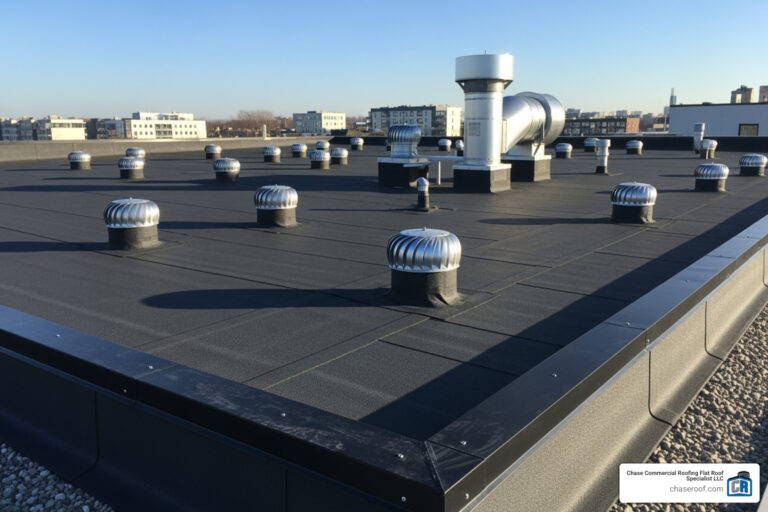
Roof-mounted breather vents are sometimes used in certain roofing assemblies, but they should not be viewed as a universal cure for trapped moisture.
Their effectiveness depends on:
- The roof assembly
- Moisture source
- Vent placement
- Air pathways
- Roof size
- Interior pressure conditions
Adding roof vents without understanding the moisture source can fail to correct the actual problem and may introduce additional roof penetrations.
Can Ventilation Dry Out a Wet Commercial Roof?
In some specialized roof systems, engineered ventilation or pressure-assisted drying strategies may be used to help manage moisture.
However, wet insulation or deteriorated roofing components cannot simply be assumed to dry successfully because vents are added.
A 2026 study indexed by NRCA examined drying strategies for low-slope roofs and emphasized that moisture can enter roof assemblies through condensation, leaks, or air leakage and can reduce insulation performance and contribute to deterioration.
The correct response depends on how wet the assembly is, what materials are affected, and whether those materials can safely remain in place.
EPDM Roof Ventilation Mistakes to Avoid
Adding Vents Without Diagnosing the Moisture Source
If moisture is entering because of a roof leak, ventilation alone will not solve the problem.
Blocking the Air Path
In a ventilated assembly, insulation or framing can prevent air from moving across the roof cavity. A functional system needs a continuous path between intake and exhaust locations.
Ignoring Interior Air Leakage
Unsealed ceiling penetrations and deck joints can allow humid interior air to move directly into the roofing assembly.
Using a One-Size-Fits-All Vent Ratio
Ventilation requirements should be based on the building design and applicable code provisions rather than copied from an unrelated residential roof.
Assuming More Ventilation Is Always Better
Roof ventilation needs to be intentional. Adding openings to an assembly that was designed to be unvented can alter air and moisture movement in ways the original system was not designed to handle.
EPDM Roof Repairs and Moisture Damage
If an EPDM roof already has trapped moisture, the first step is determining where that moisture originated and how much of the assembly has been affected.
A professional evaluation may include inspection of:
- EPDM membrane condition
- Seams
- Flashing
- Roof penetrations
- Insulation
- Roof deck
- Air-control layers
- Vapor-control layers
- Drainage
Localized membrane damage may be appropriate for commercial roof repair, while widespread wet insulation or deterioration may require a more extensive solution.
When Roof Replacement May Be Necessary
If moisture has affected a significant portion of the roofing assembly, continued patching may no longer provide good long-term value.
Replacement may be considered when there is:
- Widespread wet insulation
- Extensive membrane deterioration
- Recurring moisture problems
- Damaged roof decking
- Multiple areas of failed roofing
- An assembly that cannot be economically corrected through repair
In those situations, Chase provides commercial roof replacement in New Jersey and can help redesign the roof assembly to address moisture-control issues discovered during evaluation.
Can EPDM Be Used With Different Roof Assemblies?
Yes. EPDM is the exterior waterproofing membrane, while the components beneath it can vary considerably depending on the building and system design.
An EPDM roof assembly may include different combinations of:
- Roof deck
- Air barrier
- Vapor retarder
- Insulation
- Cover board
- EPDM membrane
The appropriate combination should be determined as a complete system rather than treating the EPDM membrane as an isolated component.
EPDM vs. TPO and Ventilation
Moisture control is not unique to EPDM. TPO, PVC, modified bitumen, and other low-slope roof systems also require appropriate air, vapor, insulation, and moisture-management strategies.
If you’re comparing roof materials, Chase also provides TPO roofing services and works with several commercial flat roofing systems.
How to Protect Your EPDM Roof From Moisture Problems
The best approach is to treat moisture control as part of the entire building envelope.
Important steps include:
- Maintain the EPDM membrane and flashing
- Repair roof leaks promptly
- Control interior humidity
- Seal significant air-leakage pathways
- Maintain roof drainage
- Use properly designed insulation
- Evaluate vapor-control requirements
- Inspect the roof periodically
- Have unusual moisture conditions investigated professionally
Let Your EPDM Roof Breathe the Right Way
Proper EPDM flat roof ventilation does not mean simply adding vents to the roof. The real goal is controlling moisture within the entire roofing assembly.
Some roof designs may use ventilation cavities. Others are intentionally constructed as unvented systems with continuous insulation, air-control layers, and appropriate vapor control. The right solution depends on the building, climate, roof deck, insulation, interior conditions, and roofing design.
Chase Commercial Roofing provides commercial roofing services throughout New Jersey, including EPDM installation and repair, flat roofing, roof replacement, coatings, and emergency roofing.
If you are experiencing condensation, recurring moisture, wet insulation, or other issues with an EPDM roof, contact Chase Commercial Roofing to schedule an assessment and determine what is actually causing the problem.