Why Flat Roofs Are So Common on Commercial Buildings
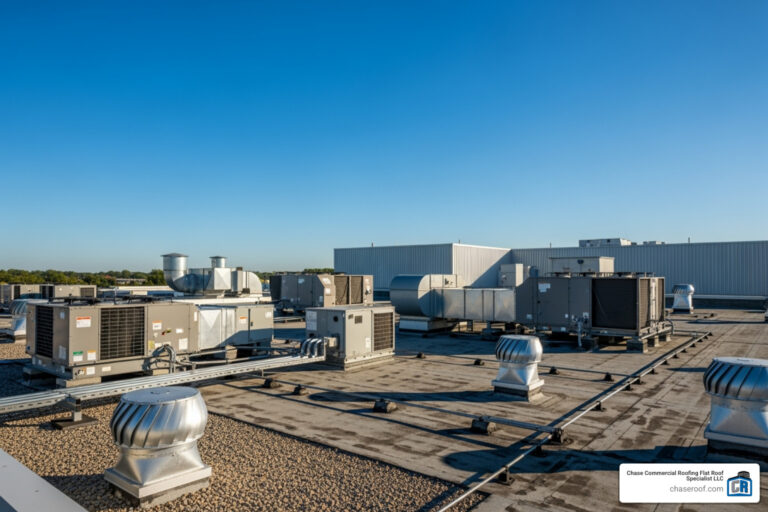
Flat roofing for businesses is common because it works well with the way commercial buildings are designed and operated. Warehouses, offices, retail centers, schools, industrial facilities, and other commercial properties often need large roof areas that can accommodate mechanical equipment, drainage systems, vents, solar installations, and other building components.
Although these roofs are commonly called “flat,” they are actually designed with slight slope so water can move toward drains, scuppers, or gutters.
At Chase Commercial Roofing, we install, repair, replace, and maintain commercial flat roofing systems throughout New Jersey.
What Makes Flat Roofing a Good Fit for Businesses?
Efficient Use of Roof Space
Flat and low-slope roofs can provide usable space for:
- HVAC equipment
- Mechanical systems
- Solar panels
- Roof access
- Other commercial building equipment
Practical Building Design
For many large commercial buildings, a low-slope design can be more practical than creating a steep roof over thousands of square feet of floor space.
Multiple Roofing System Options
Commercial building owners can choose from several roofing systems depending on budget, climate, building use, roof slope, maintenance expectations, and performance goals.
Accessible for Inspection and Maintenance
Flat roofs can often make certain maintenance and inspection tasks easier to access than steep-slope roofs, although proper fall protection and safe access procedures are still necessary.
Common Commercial Flat Roofing Systems
TPO Roofing
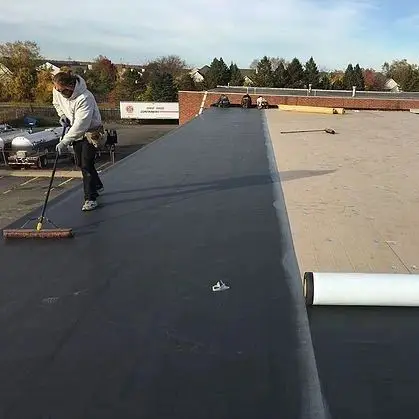
TPO, or Thermoplastic Polyolefin, is a single-ply roofing membrane widely used on commercial flat and low-slope roofs.
TPO systems typically use heat-welded seams, creating a continuous membrane across the roof surface. Light-colored TPO membranes can also provide relatively high solar reflectance.
Learn more about Chase’s TPO roofing services in New Jersey.
EPDM Roofing
EPDM is a synthetic rubber roofing membrane that has been used on commercial buildings for decades.
It is known for flexibility and its ability to accommodate temperature changes when properly designed and installed.
Chase provides EPDM roofing services throughout New Jersey.
PVC Roofing
PVC is another thermoplastic single-ply roofing membrane.
Like TPO, PVC seams are typically heat-welded. Some PVC roofing systems are also selected for buildings where resistance to certain chemicals, grease, or oils may be important.
Modified Bitumen
Modified bitumen combines asphalt with polymer modifiers to create a flexible multi-layer roofing system.
It may be installed using different methods depending on the manufacturer and specific roof assembly.
Built-Up Roofing
Built-up roofing, commonly called BUR, uses multiple layers of bitumen and reinforcing materials to create a multi-ply roof system.
It has a long history in commercial roofing and remains an option for certain properties.
Metal Roofing
Metal roofing may be appropriate for some commercial buildings depending on roof slope, structural design, and the specific panel system being considered.
For compatible properties, Chase provides commercial metal roofing services.
Comparing Commercial Flat Roof Options
| Roofing System | Type | Common Strengths |
|---|---|---|
| TPO | Single-ply thermoplastic | Heat-welded seams, reflective options, widely used on commercial buildings |
| EPDM | Single-ply synthetic rubber | Flexible, established commercial roofing material |
| PVC | Single-ply thermoplastic | Heat-welded seams and specialized chemical-resistance options |
| Modified Bitumen | Asphalt-based multi-layer system | Durable, flexible, multiple installation methods |
| BUR | Multi-ply asphalt system | Multiple waterproofing layers and long commercial history |
| Metal | Panel system | Durability and architectural appearance for compatible roof slopes |
How to Choose the Right Flat Roof for Your Business
The best roofing system is not automatically the one with the lowest initial price or the longest advertised service life.
A commercial roofing contractor should consider:
- Roof slope
- Building use
- Existing roof condition
- Climate
- Drainage
- Rooftop equipment
- Interior humidity
- Energy goals
- Budget
- Maintenance expectations
Commercial Roof Insulation Matters Too
The membrane is only one part of a commercial roof.
Insulation can affect:
- Thermal performance
- Roof slope
- Drainage
- Condensation control
- Attachment
- Code compliance
Insulation type and thickness should be considered as part of the complete roof assembly rather than chosen separately from the roofing membrane.
What Is a Cool Roof?
A cool roof is designed to reflect more solar energy and absorb less heat than a conventional darker roof surface.
Some TPO, PVC, coated, and metal roofing products are available with higher solar reflectance.
The U.S. Department of Energy explains that cool roofs can reduce roof surface temperatures and may lower cooling demand in certain buildings and climates.
Property owners can review the U.S. Department of Energy’s cool roof guidance for additional information.
Actual savings depend on climate, insulation, building use, HVAC efficiency, roof characteristics, and other factors.
Commercial Flat Roof Drainage
Drainage is one of the most important parts of a flat roofing system.
Commercial buildings may use:
- Internal roof drains
- Scuppers
- Gutters
- Downspouts
- Overflow drains
If water repeatedly remains on the roof, the cause may involve clogged drains, low areas, compressed insulation, deck movement, or inadequate drainage design.
Common Commercial Flat Roof Problems
Ponding Water
Recurring standing water should be evaluated rather than assumed to be normal.
Membrane Punctures
Foot traffic, maintenance work, tools, or storm debris can puncture single-ply roofing membranes.
Open Seams
Damaged or separated seams may allow water beneath the roof membrane.
Flashing Failure
Flashing around equipment, walls, roof edges, pipes, and drains is a common area for leaks to develop.
Drainage Problems
Blocked drains or scuppers can allow water to accumulate and increase exposure around vulnerable roof areas.
Professional Installation Makes a Difference
Commercial flat roofing systems rely on correct installation of multiple components, including:
- Insulation
- Cover boards
- Membrane
- Seams
- Flashing
- Roof edges
- Drainage
- Penetrations
A qualified contractor should understand the manufacturer requirements and building conditions involved with the selected roofing system.
Commercial Roof Safety
Flat roofs may look easy to access, but they still present serious fall hazards.
Roof edges, skylights, openings, wet membranes, ladders, and rooftop equipment all require appropriate safety procedures.
OSHA provides specific requirements for construction fall protection, including roofing work.
Review OSHA’s construction fall-protection requirements for more information.
How Often Should Commercial Flat Roofs Be Inspected?
Inspection frequency should be based on the actual property and roofing system.
Factors include:
- Roof age
- Roof material
- Building use
- Storm exposure
- Rooftop traffic
- Previous leaks
- Warranty requirements
Many commercial property owners incorporate seasonal roof inspections and additional inspections after significant storms or rooftop work.
The National Roofing Contractors Association provides guidance and training covering roof-system inspection, maintenance, leak detection, and repairs.
Review the NRCA’s roof repair and maintenance guidance.
What Should Commercial Roof Maintenance Include?
A maintenance program may include:
- Clearing drains and scuppers
- Removing debris
- Inspecting seams
- Checking flashing
- Inspecting penetrations
- Monitoring ponding areas
- Reviewing previous repairs
- Documenting roof condition
Can Flat Roofs Be Repaired?
Yes. A leak does not automatically mean the roof needs replacement.
Localized repairs may involve:
- Membrane patches
- Seam repairs
- Flashing repairs
- Drain repairs
- Penetration repairs
Chase provides commercial roof repair throughout New Jersey.
When Does a Flat Roof Need Replacement?
Replacement may become more appropriate when:
- Roof deterioration is widespread
- Leaks repeatedly develop across the roof
- Large areas of insulation are wet
- Deck damage is present
- Repair costs continue to increase
When needed, Chase provides commercial roof replacement in New Jersey.
Can Roof Coatings Extend the Usefulness of an Existing Roof?
Some serviceable roofing systems may qualify for restoration using a coating system.
However, active leaks, damaged membrane, wet insulation, and other defects should be addressed before coating.
For compatible roofs, Chase offers commercial roof coating services.
Understanding Commercial Roofing Warranties
Commercial roofing warranties vary significantly.
Depending on the project, there may be:
- Manufacturer material warranties
- Manufacturer system warranties
- Contractor workmanship warranties
Coverage depends on the roofing system, manufacturer, contractor qualifications, installation method, and warranty option selected.
Always review the actual written warranty rather than assuming every commercial roof receives the same coverage.
How to Choose a Commercial Roofing Contractor
Look for a contractor with experience in the type of building and roofing system you have.
Important considerations include:
- Commercial roofing experience
- Experience with your specific system
- Appropriate insurance
- Applicable credentials
- Manufacturer training or certifications where relevant
- References
- Customer reviews
- Detailed written proposals
- Safety procedures
Flat Roofs Mean Business
Flat roofing for businesses remains popular because commercial property owners have a wide range of systems that can be tailored to building design, climate, drainage, energy goals, and budget.
TPO, EPDM, PVC, modified bitumen, BUR, metal roofing, and coating systems each have different strengths. The right choice depends on the property—not on a single material being universally “best.”
Chase Commercial Roofing provides commercial roofing services throughout New Jersey, including TPO, EPDM, flat roofing, metal roofing, repair, replacement, coatings, maintenance, and installation.
If you’re planning a new commercial roof or evaluating an existing flat roofing system, contact Chase Commercial Roofing to schedule an assessment and discuss the options for your building.